Agents that can work together

TL;DR
- AI works best on one narrow job at a time. Everything an AI is looking at, its "context," costs money and attention. One agent that holds a whole bid gets expensive and starts missing things.
- Real construction work needs many specialist agents working together. A bid, a takeoff and a bid strategy are each made of smaller jobs. Today, agents built by different companies can't work together.
- The Standard Agent Specification fixes that. It's a new open standard that defines a whole agent in writing, so agents can be shared, combined, checked by a person and run the same way every time.
- We're moving Bidlo's agents toward it, so your company's process can become agents you own and control.
Most AI agents today are one-offs. Every company builds its own, in its own way, and none of them can be shared or combined. This month, the team at Standard Agents released an open standard meant to fix that: the Standard Agent Specification. The talk above, by lead maintainer Justin Schroeder, is the best introduction to it.
We agree with it, and we're moving Bidlo's agents toward it. This post explains what the standard is and why it matters to the contractors who use Bidlo (and other AI tools) to bid and build work. First, one idea that everything else depends on.
Managing "context"
When you ask an AI to do something, it can only work with what's in front of it at that moment: your question, the documents you gave it, its instructions, and the list of tools it's allowed to use. All of that together is its context.
Think of context as the AI's desk. Everything it needs for the job has to be on the desk at the same time. Anything that isn't on the desk, it can't see.
The desk has a fixed size, and it isn't free:
- Every page costs something. AI is paid for by how much it reads. A 400-page plan set on the desk is read again on every step, and that adds up.
- A bigger desk needs a bigger model. Only the largest, most expensive models can hold a lot at once.
- A crowded desk gets sloppy. Even the biggest models start missing things when the desk is piled high. The addendum on page 12 of the stack gets skimmed, not read.
So the question for any agent is the same one you'd ask about a person: what does it actually need in front of it to do this job well?
A bid is too big for one agent
Think about everything that goes into a single highway bid: a 400-page plan set, the specs, four addenda, the bid tab, vendor quotes, the bid bond form, DBE goals, haul routes, and the last ten times you bid something like it.
The easy way to build an AI agent is to put all of it on one desk. Give one model every document and every tool, write a long set of instructions, and hope it keeps track.
That works for small jobs. On a real bid it breaks down.
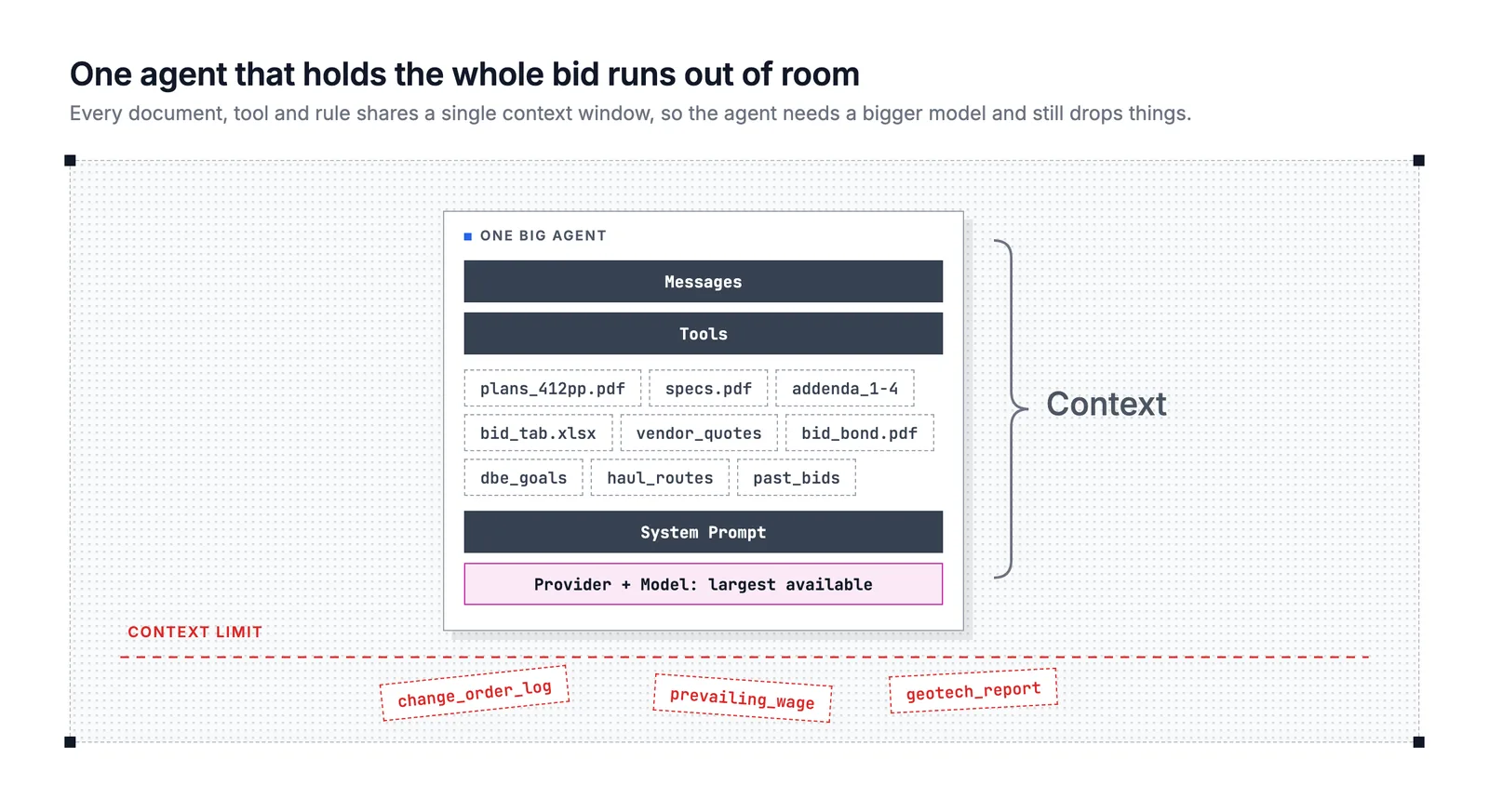
Stacking every job into one agent always fails eventually. The fix has been known for a long time: don't build one agent that does everything. Build several that each do one thing, and have them work together.
And a whole bid is just one example. Zoom in on any part of it and the same thing happens. A takeoff is one step inside bidding, and it's still too much for one agent: traffic control, earthwork, paving and drainage are each better handled by their own specialist. Your bid strategy is the same. Deciding whether a job fits your five- or ten-year plan means looking at what's coming up across the owners and scopes you care about, what you've historically done well, and the risk of moving into a new market. Each of those can be its own agent. And that's all before you start building the job you win.
This is one of many, many examples contractors deal with. Almost every real process is made of smaller jobs, and each of those is better handled by a specialist.
Narrow agents do better work
Good estimating departments already work this way. You don't have one person read the plans, check the bond, chase subs and run the numbers all at once. Each person owns a piece, and someone pulls it together.
A narrow agent, one that only reads addenda or only checks bid bond forms, has three advantages:
- It stays focused. Its desk holds one job, so nothing gets crowded out.
- It can run on a smaller model. A low-cost model can do an excellent job as a bid bond checker. It only falls apart when you ask it to be much more than that. Cheaper models mean more work for the same credits.
- It can be tested. You can't easily grade an agent that does everything. You can grade one that checks bid bonds: run it against fifty past bonds and know how often it's right.
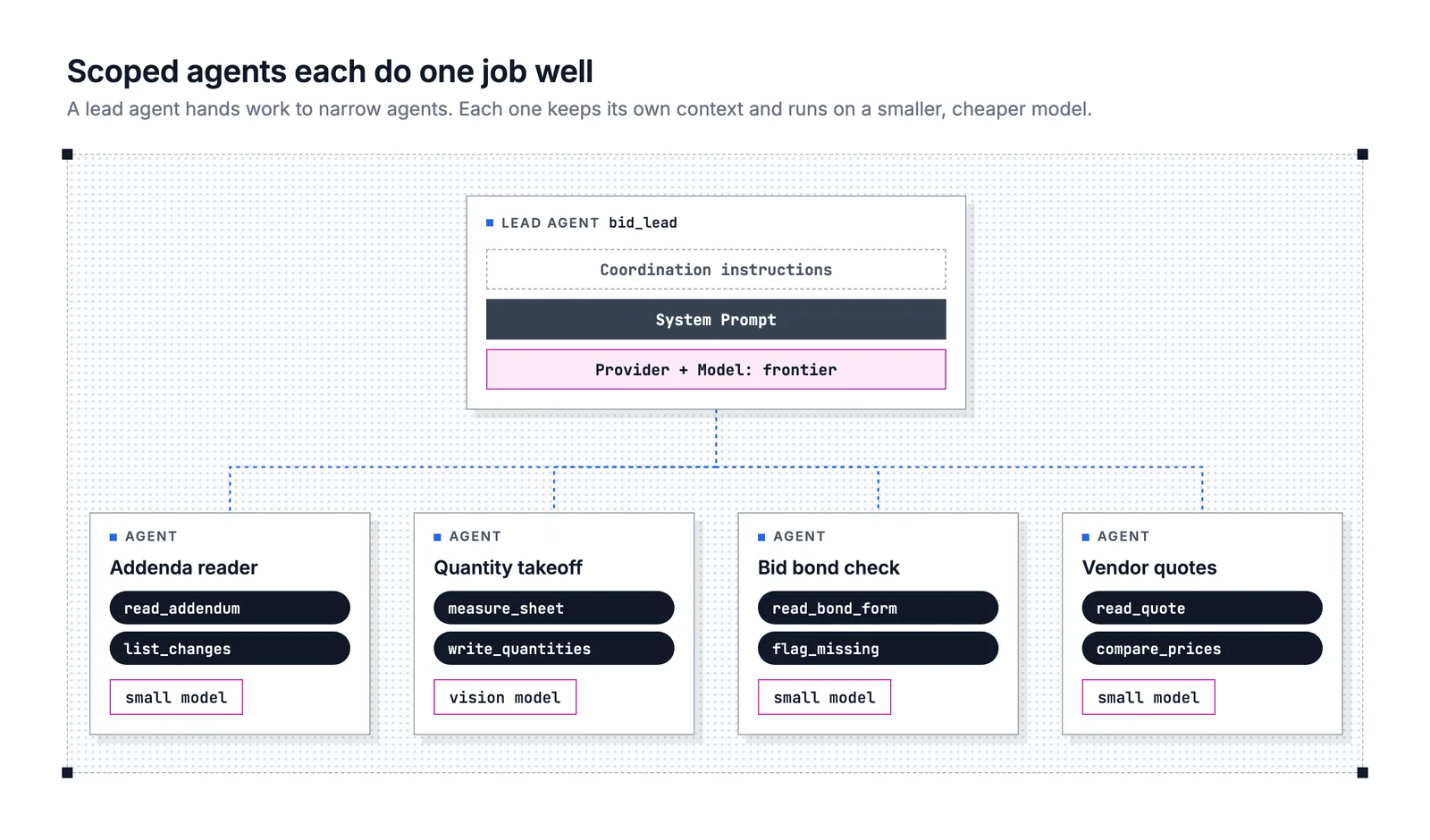
A lead agent coordinates. It hands the addenda to the addenda reader and the bond form to the bond checker, and gets back a short answer from each. The lead's own desk never fills up with 400 pages of plans.
Narrow agents are also safer. If an agent can do anything, it might do anything, and that's a liability. An agent that can only read a bond form and flag what's missing can't decide to email your surety.
Why agents can't work together today
Splitting work into many agents creates a new problem. To build an agent, every company builds its own harness: the code that decides what goes on the desk, which tools the agent can use, and when it stops. Every harness is different: different languages, different rules for tools and memory, different ideas about when the job is done.
Two agents built on two different harnesses are fundamentally incompatible. You can't take one company's addenda reader and plug it into another company's bid workflow.
There are already standards around agents. MCP gives agents a common way to reach tools. Skills and AGENTS.md give them a common way to receive instructions. But nothing defined the agent itself, until now.
What the Standard Agent Specification is
The Standard Agent Specification defines the whole agent. It's open source under the MIT license, maintained by the team at Standard Agents, and currently at version 0.2.0.
Every part of an agent is written down in code:
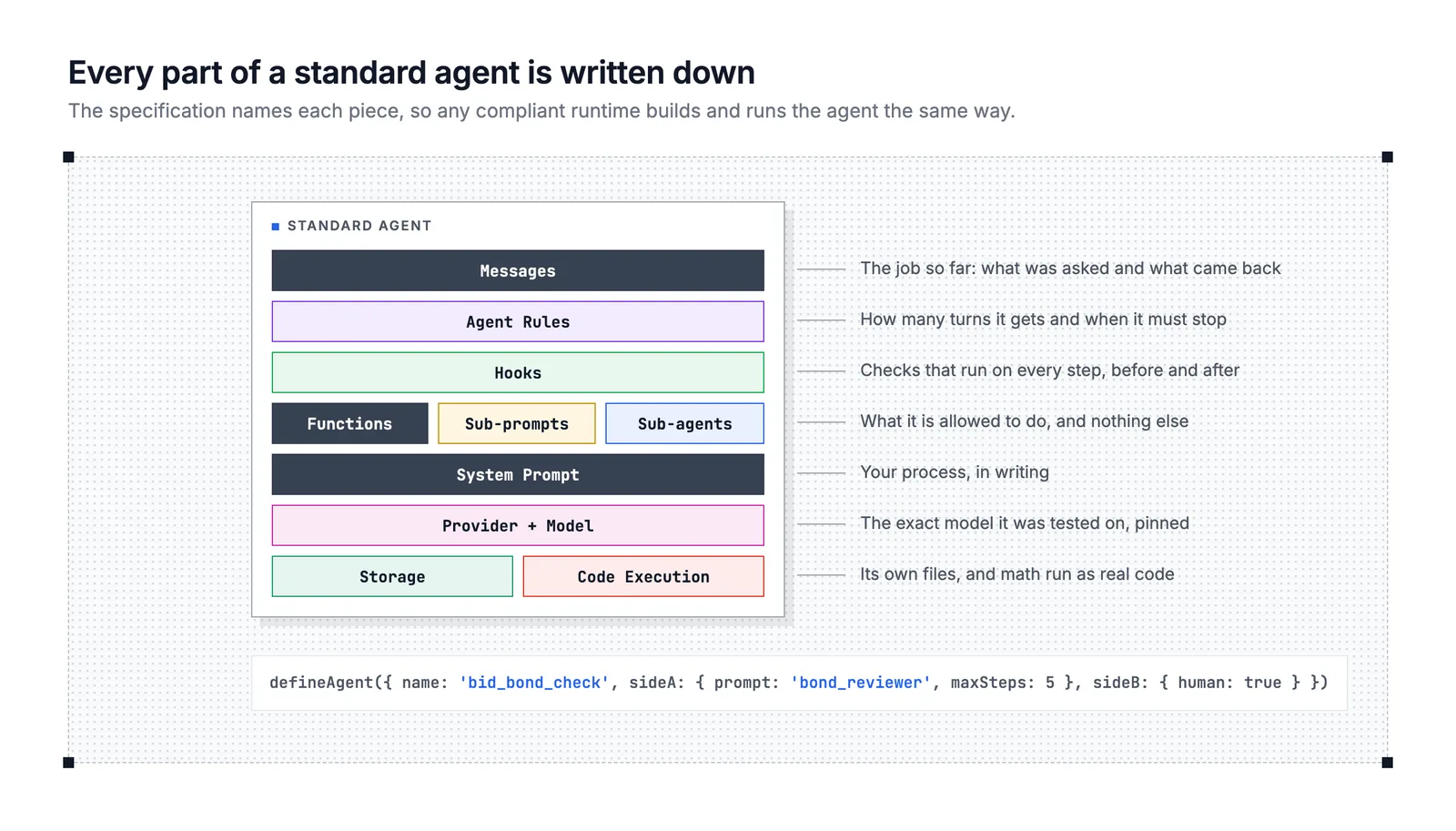
- Prompt. The instructions, which for us means your process.
- Model. The exact model the agent was built and tested on, pinned so it doesn't change under you.
- Tools. The specific actions it's allowed to take, and nothing else. A tool can be plain code, a smaller prompt, or another agent.
- Rules. How many turns it gets and when it has to stop.
- Hooks. Checks that run before and after each step.
- Storage. Its own files, kept separate from every other agent's.
A standard agent runs inside a runtime, the program that executes it, the same way a document opens in any program that reads the file format. Any runtime that follows the spec runs the agent the same way, every time.
That buys four things: agents are faster to build, because the design decisions are already made; they behave consistently; they're portable, so you can pack one up and move it; and they're composable, so agents can be built out of other agents.
Two sides, and a seat for the estimator
The simplest idea in the spec is also the most useful. Every agent has exactly two sides, and each side is filled by a person, an AI model, or plain code.
An everyday chat assistant is a person on one side and a model on the other. Other pairings get more interesting:
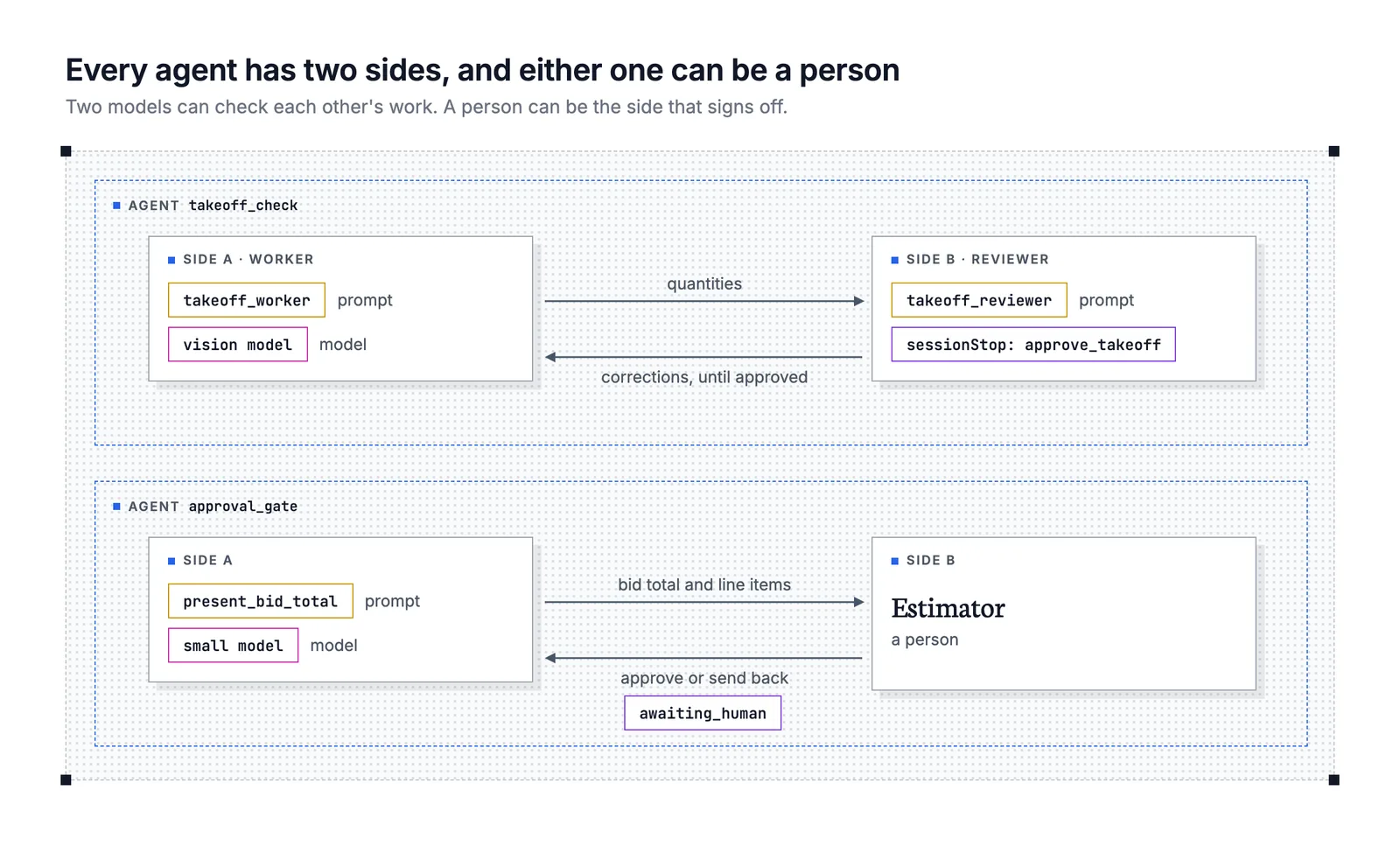
- Worker and reviewer. Put a model on both sides. One does the takeoff. The other checks it and sends back corrections until it's satisfied. Quality control is built into the agent.
- Approval gate. Put a person on one side. The agent lays out the bid total and the line items, then stops and waits for the estimator to approve it or send it back.
That second one matters to us. Bidlo's agents can do more of the work every month, but the number that goes in the envelope is still yours. The spec gives a person a defined place inside an automated process instead of treating them as an afterthought.
Your process, packaged
A business is really just its processes. Your company's way of checking a bond, leveling sub quotes or reading an addendum is what makes you competitive.
That's why most companies don't want to hand their most important work to a general-purpose AI and hope it does it the same way twice. The process needs to run the same way every time, in your company's own way. What businesses want is control.
The spec's answer is packaging. A standard agent, with its prompt, tools, model, rules and hooks, ships as one installable package. It can be versioned, copied, adjusted and reinstalled.
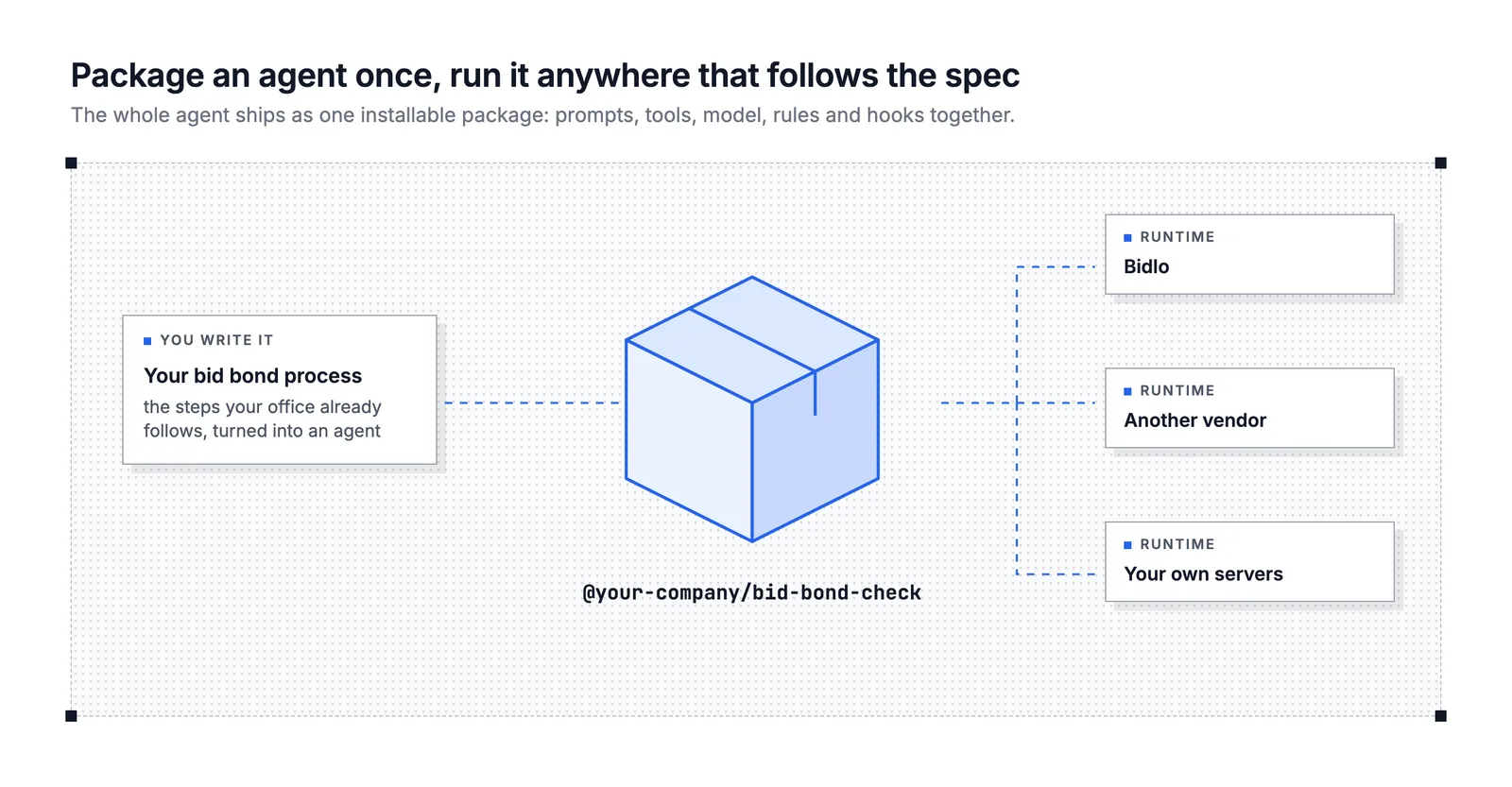
For Bidlo customers, that points to three things:
- Your process stays yours. An agent built around how your office works is something you can keep, version and move, not settings trapped inside one product.
- Agents that run the same way twice. A pinned model and written rules mean last month's bond check behaves like this month's.
- Agents you didn't have to build. Once agents share a standard, a good one, like a DOT-specific addendum reader, can be built once and installed by everyone who needs it.
What an agent looks like
Here is an example agent written to the spec. It checks bid bond forms. You don't need to read code to follow it. It reads a lot like a form someone filled out.
First, the instructions and the model it runs on:
definePrompt({
  name: 'bond_reviewer',
  toolDescription: 'Checks a bid bond form for anything missing',
  model: 'small_reader',
  prompt:
    "Check the bid bond form against the owner's requirements. List anything missing or wrong.",
  tools: ['read_bond_form', 'flag_missing'],
});
Then the agent itself. The model on one side does the check. The estimator who asked for it is on the other.
defineAgent({
  name: 'bid_bond_check',
  sideA: {
    prompt: 'bond_reviewer',
    stopOnResponse: true,
  },
  sideB: { human: true },
});
That's the whole agent: what it does, which model it uses, which two tools it can touch, and who it answers to.
Now say your office changes its rules. From now on, every bond check should:
- Stop after five steps, so it can't run up a bill going in circles.
- Get a second opinion on the surety's letter from a specialist built for that.
- Have a hard cap on how much back-and-forth one check can take.
Here's the new version. The new lines are marked:
defineAgent({
  name: 'bid_bond_check',
  maxSessionTurns: 6, // new: a cap on back-and-forth
  sideA: {
    prompt: 'bond_reviewer',
    stopOnResponse: true,
    maxSteps: 5, // new: stop after five steps
    subagents: [
      // new: a specialist checks the surety letter
      { agent: 'surety_letter_check', blocking: true },
    ],
  },
  sideB: { human: true },
});
Three changes, and every one is written down. You can see exactly what the agent did last month and what it does now, and any runtime that follows the spec will run the new version the same way.
Where this goes
The spec is early. Version 0.2.0 comes before a 1.0 release, and its maintainers are clear that it isn't finished. Parts of it will change, and we expect to help shape some of them.
This moment looks a lot like the early web, when every browser pushed its own features until a shared standard let the whole thing grow. Agents are at the same point. Construction is a good place to prove it: bids are made of many narrow, checkable jobs, and the stakes are high enough that every one of them needs to be done right, the same way, every time.
We'll share more as we build.
Sources
- Standard Agent Specification
- Every Company Is Building Agents That Can't Work Together, Justin Schroeder, Standard Agents (AI Engineer, November 2026)
- Agents and Subagents in the specification
- Examples
- Specification on GitHub
- Standard Agents