Agents don't need workflow builders

TL;DR
- Workflow builders like Zapier and n8n let people automate without code, but the logic underneath was always code, and keeping it drawable took a lot of workarounds.
- Agents are now the interface, and they write code far better than graph formats. Even n8n has its AI write TypeScript and then converts it into a graph.
- Without the canvas the workarounds disappear, so the system gets simpler and cheaper. The market is already moving this way, and the graph survives only as a view of what ran.
Why we drew boxes
Automation used to need a programmer. Visual workflow builders like Zapier, Make and n8n removed that need. Drag a trigger, wire up some nodes, and a sales manager could connect a form to a CRM. The boxes lit up green when they ran and red when they failed, so anyone could see what happened.
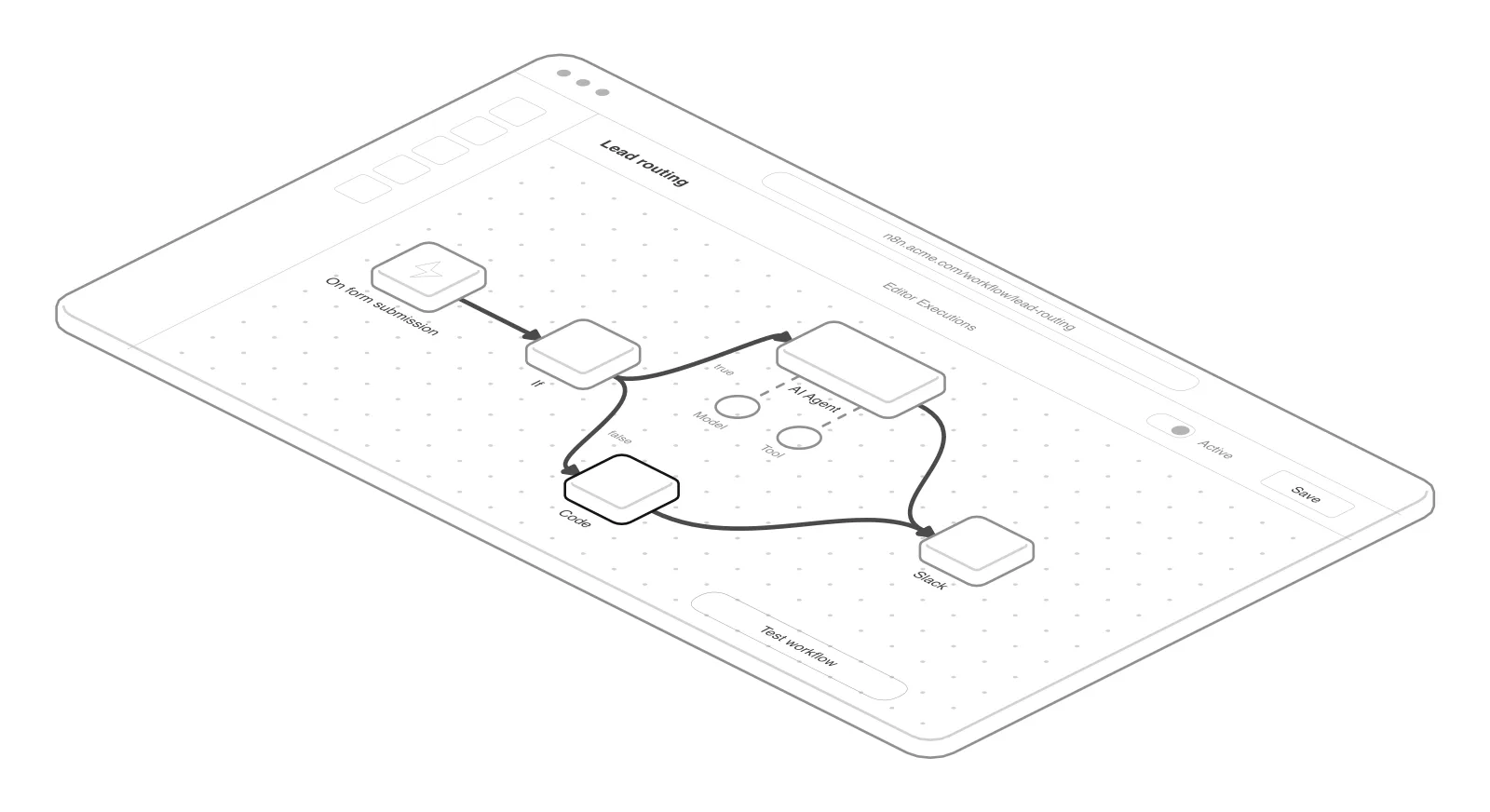
That is a real achievement, and it is why Zapier claims more than 3 million businesses as users. It solved a human problem: people who can't read code need a picture to build and check their automations.
The gymnastics
Making that picture editable takes a lot of machinery, and most of it exists only to keep the picture working.
The logic moved into strings. A canvas can't express "if the total is over 100 and the customer is new". So every builder added an expression language inside node fields, plus a Code node for when that runs out. Across 2,001 public n8n templates, about half contain a Code node and 54% contain a raw HTTP node. There is roughly one {{ }} expression per node. The canvas promised no code; in practice it is code split into boxes.
The picture has limits that code doesn't. A Zap allows 100 steps and no nested loops. Users who need more branching split one process across several Zaps and lose the single view the canvas was for.
Every vendor invented a format. Zapier, Make, n8n, Power Automate and Workato each store workflows as their own JSON graph. None is a standard, and several are undocumented.
Version control fights the format. Moving one node in Node-RED produced about 1,000 changed lines in a git diff. n8n diffs are "hundreds of lines of raw JSON: timestamps, IDs and canvas positions". Users call hand-merging two versions a nightmare. Git sync is a paid tier in both n8n and Activepieces.
Names hold the graph together. n8n wires nodes by display name, so renaming a node breaks retries of past runs. Zapier won't replay a failed run once steps have been added, moved or deleted.
Every run saves every node's data. The picture is valuable because you can click any node and see what went in and out. To support that, n8n saves each run as one large blob, and users report 21 GB to 50+ GB tables. n8n is now rebuilding its engine.
None of this is careless engineering. It is what it costs to keep a program editable by hand as a drawing.
The agent is the interface now
Today the person describes what they want and an agent builds it. The agent doesn't need a picture to write the program. It needs a language it knows, and it knows code.
The graph vendors found this first. n8n's AI builder used to edit the canvas directly, through tools like add_node and connect_nodes. Now it writes TypeScript, and n8n converts that into its graph without running it. According to n8n, writing the JSON directly "proved very difficult": models have seen about ten thousand n8n workflows and millions of TypeScript files. Here is the same workflow both ways:
{
  "nodes": [
    {
      "name": "Start",
      "type": "n8n-nodes-base.manualTrigger",
      "typeVersion": 1,
      "parameters": {}
    },
    {
      "name": "Fetch Posts",
      "type": "n8n-nodes-base.httpRequest",
      "typeVersion": 4.3,
      "parameters": { "method": "GET", "url": "https://api.example.com/posts" }
    }
  ],
  "connections": {
    "Start": {
      "main": [[{ "node": "Fetch Posts", "type": "main", "index": 0 }]]
    }
  }
}
const start = trigger({
type: 'n8n-nodes-base.manualTrigger',
version: 1,
config: { name: 'Start' },
});
const fetchPosts = node({
type: 'n8n-nodes-base.httpRequest',
version: 4.3,
config: {
name: 'Fetch Posts',
parameters: { method: 'GET', url: 'https://api.example.com/posts' },
},
});
export default workflow('example', 'Fetch posts').add(start).to(fetchPosts);Look at what that pipeline does. The agent writes code, and n8n converts it into a graph so a person can see it. The canvas has become a translation layer between the agent and the logic.
Others hit the same problem:
- Workato built a linter because agents were "guessing blind at connector configuration, datapill syntax, and control flow". Its recipe format "isn't well represented in training data".
- Zapier has no import that updates an existing Zap. One customer has Claude rewrite exported Zap JSON, then retypes the changes by hand.
- Make users get LLM-written blueprints that are valid JSON but not valid blueprints.
The benchmarks agree. On ComfyBench, a model writing workflows as code passes 45% of complex tasks, against 25% when writing JSON. IBM's Flow-Bench has models write Python and converts it to BPMN afterwards, because the BPMN is about 25 times longer. On Chat2Workflow, the best model fully solves only about 60% of Dify's JSON workflows.
Without the canvas, the system gets simpler
Take the canvas out and each workaround loses its reason to exist. Loops and branches are just code. Diffs, review, tests and refactoring use the tools every developer already has. Renaming a step is a rename. Instead of a format nobody was trained on, the agent writes the language it knows best.
It also gets cheaper. When an agent writes the automation, the model's work happens once, at build time. After that, plain code runs it.
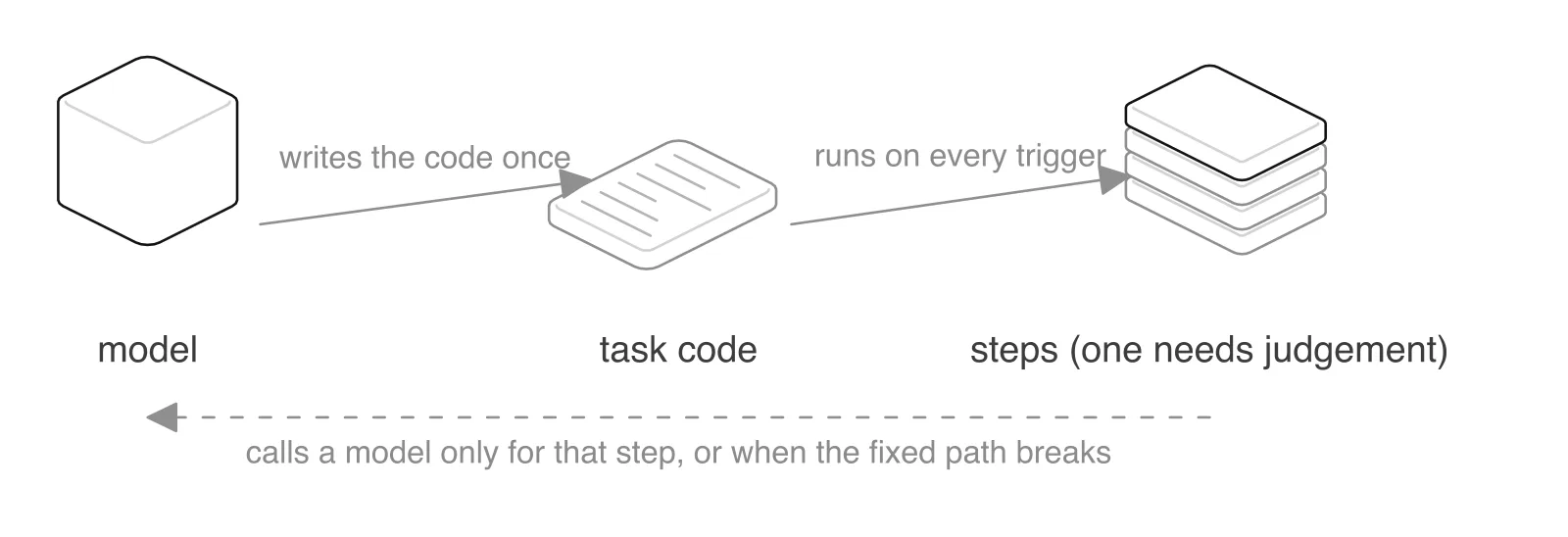
Zapier measured this across 2,944 workflows. Letting a model run the workflow cost 2.1 times as much as fixed code overall, and 8.3 times as much for workflows that run fewer than 30 times a month. Its advice: "use AI to build the workflow and handle reasoning. Let conventional software run it." Tines built a product around this: "When your story executes, only that Python code runs. No AI is involved at runtime."
The market is moving
- OpenAI launched Agent Builder, a canvas of typed nodes, in October 2025. It shuts down on November 30, 2026. The way out is to export your workflows as Agents SDK code.
- Pipedream was bought by Workday. Its workflow builder closes on March 31, 2027. Connect, the API and MCP layer that gives agents access to apps, stays.
- Zapier shipped a TypeScript SDK for coding agents, and folded its standalone agent product into one step inside a Zap.
- Salesforce rebuilt Agentforce around Agent Script. Its rule: "if you can express a decision as code, it should be written as logic."
- AWS launched Lambda durable functions for logic "tightly coupled with business logic". It points people to Step Functions only when "you need visual design".
- Windmill, a flow-first product, added workflows written as plain TypeScript or Python.
Code-first tools take only one thing from the canvas, the view. Mastra draws a graph from workflow code. Temporal, Inngest and Trigger.dev draw a timeline of each run. None of them lets you edit the picture.
What's left of the canvas is a view
Ask people what they valued in workflow builders and you rarely hear "dragging boxes". You hear: click a run, see what went in and out of each step, retry the step that failed. That is about reading, not writing, and you can draw it from code.
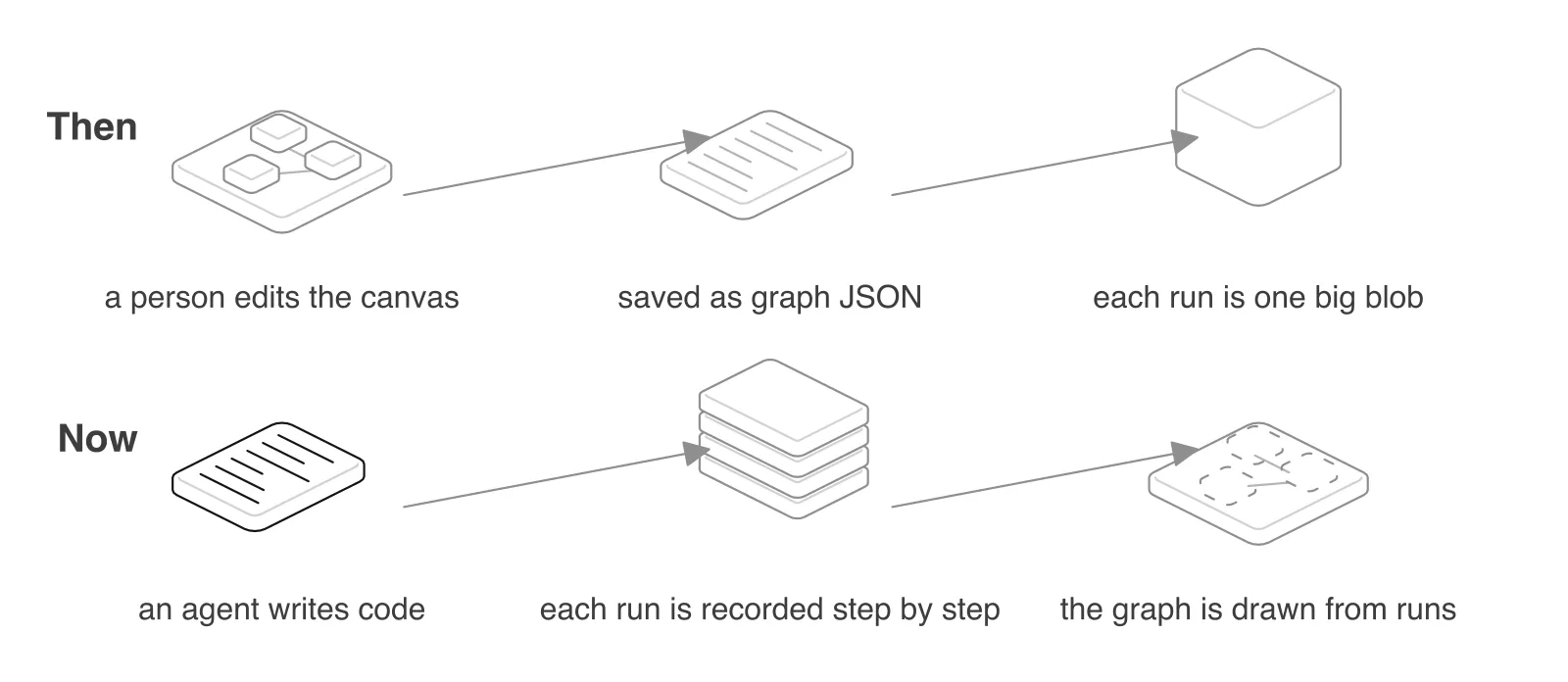
A graph is a good way to read a run and a poor way to write a program.
Where this argument is weakest
Code has its own traps. Durable workflow engines re-run your function after a crash, so the code must follow rules a canvas never asked of anyone, and changing code while runs are in flight is still the top pain in every code-first engine.
Structured formats aren't dead either. Kestra argues that YAML can be checked against a schema without running it, and Airflow added an experimental YAML format in November 2026. What is going away is the hand-edited canvas, not structure.
The biggest open question is people who don't write code. They used the canvas to check the work themselves. Nobody has yet shown they can own chat-built code over the long run.
The canvas was built so people could program by drawing. Now that agents do the programming, people only need to read the result.
Repos read: n8n @ acd9d7a, Node-RED @ f324616, Windmill @ cf8a1c3, Temporal @ 4197dfd, Inngest @ 72e7d1c, Trigger.dev @ a34ccdc, Kestra @ d2757e9, Airflow @ e494b86, and 38 more.